

[ad_1]
This submit is a part of our collection on Toddler Sleep and its Impacts on Growth, revealed in collaboration with the journal Infant Behavior and Development. The featured analysis appeared in a special issue on how toddler sleep impacts cognitive, social, and bodily growth and the way mother and father and practitioners can assist promote wholesome sleep and growth in infancy.
Key takeaways for caregivers
- Earlier than their first birthday, most infants sleep 12 hours a day and might sleep by way of the night time.
- Infants who had good-quality and enough night time sleep at eight months had better language development and better cognitive skills at 14 months.
- Infants with good sleep high quality had larger morning cortisol ranges than these with lower-quality sleep, which can replicate extra mature mind group.
- As a result of sleep promotes studying and brain development, caregivers ought to be taught sleep routines and techniques that assist infants learn to sleep by way of the night time.
The sleep-wake circadian cycle and studying
Within the early months, newborns sleep about 75% of a 24-hour day. By 9 months, they sleep about 50% of a 24-hour cycle. A circadian rhythm (or internal clock-like indicators) develops throughout the first 12 months to determine an adult-like sample of being awake throughout the day and asleep at night time. Nonetheless, after their first birthday, about 20% to 30% of toddlers proceed to have night time wakings or poor night time sleep.
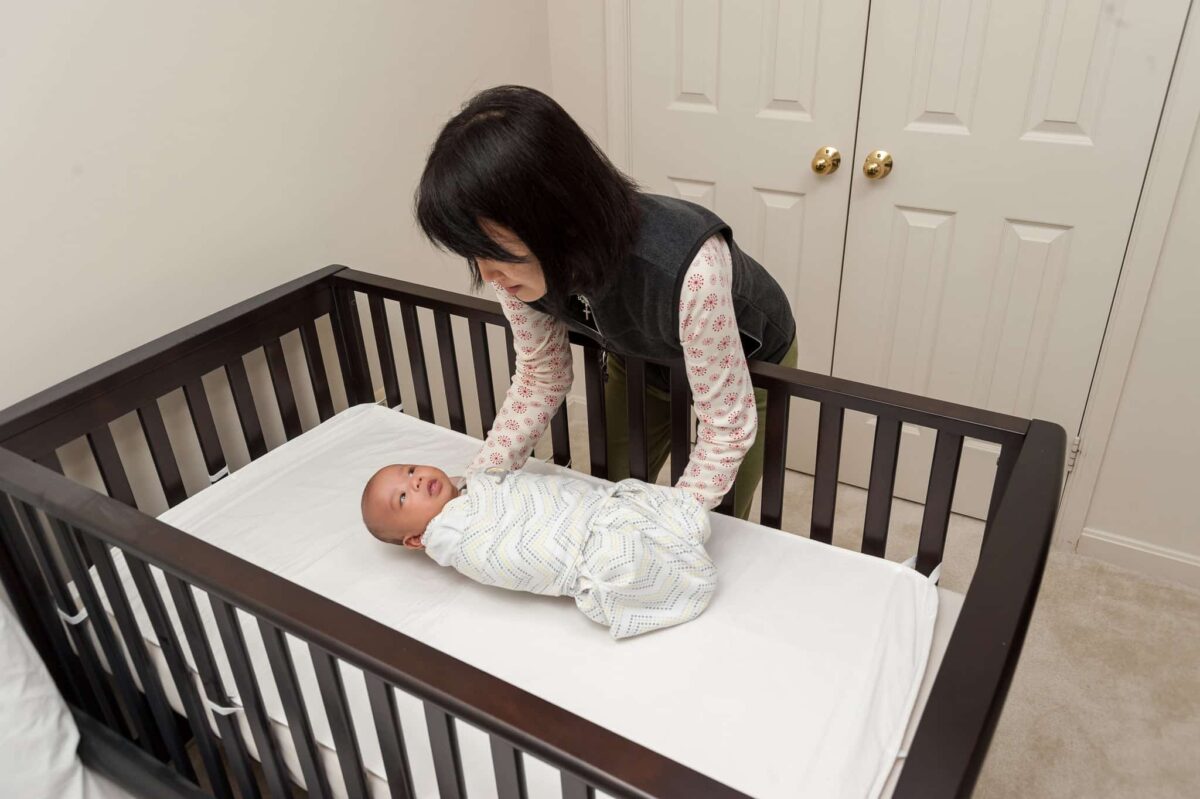
Picture: NICHD. Artistic Commons.
Sound toddler sleep is vital for wholesome growth. Analysis means that the amount and high quality of infants’ sleep are linked to studying and mind growth. For instance, infants who sleep for shorter durations have poorer reminiscences, and infants who’ve problem sleeping at night time have bother remembering new phrases.
Sleep and stress response cycles
Whereas growing a sleep-wake cycle, infants’ circadian rhythm additionally develops to reply to stress. When stress is perceived, a cycle begins that releases cortisol, a stress hormone that gives a lift of saved power to assist the physique get by way of the stressor. The additional increase helps the person cope with the stressor by way of the struggle or flight response.
Stressors usually are not at all times excessive or intense in nature. For instance, infants typically present misery when crying and fidgeting throughout a diaper change, when overstimulated, or when hungry or sleepy. Each interplay and alter in an toddler’s day is usually a stressor and might result in a cortisol response that helps put together the physique to reply to stress.
Optimum sleep (i.e., sleeping sufficiently and soundly by way of the night time) at eight months was related to larger studying and language abilities at 14 months.
Cortisol turns into unhealthy when it’s repeatedly launched and stays elevated. Such elevated ranges have been linked to poor studying and functioning, suggesting that an excessive amount of cortisol might hurt mind growth.
In adults, cortisol ranges are usually excessive within the morning, lower steadily over the day, and are low at night time as sleep approaches. Infants are thought to imitate the grownup day-night cortisol circadian rhythm; nonetheless, few research have explored the relation between infants’ cortisol and sleep cycles.
Do toddler sleep and cortisol relate to later language and studying abilities?
We performed a study to raised perceive if infants’ high quality of sleep pertains to their later language growth and total studying skills. The infants had been White and from middle-class households, and so they attended a high-quality childcare program in a southeastern state in the US.
When infants reached eight months and once more at 14 months, mother and father answered questions associated to their infants’ sleep routine, sleep setting, and the standard and amount of their infants’ sleep. At each time factors, the kid care supplier accomplished assessments of the toddler’s communication and language abilities (e.g., nods head to point sure, makes use of sounds/phrases to get consideration) and studying and cognitive abilities (e.g., imitates, seems to be, or factors to an object when requested the place it’s).
To start to discover the position of cortisol ranges within the connection between sleep and studying within the early years, we additionally collected morning saliva from the infants at each time factors.
Infants with higher night time sleep had higher language and cognitive skills as toddlers
In our examine, we requested whether or not infants who had common sleep routines and good nighttime sleep developed higher language and studying/cognitive abilities than infants with irregular sleep routines and poor nighttime sleep. We discovered that optimum sleep (i.e., sleeping sufficiently and soundly by way of the night time) at eight months was related to larger studying and language abilities at 14 months. These findings counsel that reaching good high quality and amount of sleep earlier than the primary birthday might relate to younger toddler’s later language development and overall learning.

Picture: hessam nabavi. Unsplash.
Larger morning cortisol stress hormone ranges associated to raised toddler sleep
We additionally checked out whether or not morning cortisol stress hormone ranges of 14-month-olds had been associated to sleep on the similar age. We discovered that toddlers who had optimum night time sleep additionally had the best morning cortisol stress hormone ranges. In adults, cortisol ranges are typically larger shortly after waking. Thus, the upper cortisol ranges in toddlers might point out extra mature mind growth in toddlers who had higher nighttime sleep.
Sleep enhances early mind growth
Our findings confirmed that optimum sleep in infancy was related to higher language and studying abilities in toddlerhood. These outcomes are per the concept sleep enhances early mind growth. One rationalization for why sleep helps an toddler’s brains develop is that sleep triggers the discharge of mind chemical compounds, or neurotransmitters, that construct and strengthen the mind’s pathways for forming reminiscences of data an toddler discovered that day.
Good sleep additionally prepares infants to be taught the following day. Younger toddler’s studying alternatives usually happen by way of daytime interactions. When toddler’s have slept nicely, they could get up extra relaxed and able to interact. In distinction, infants who haven’t slept nicely might awaken sluggish, irritable, and fewer able to socialize and learn. As a result of sleep is vital for solidifying previous studying and getting ready kids to be taught much more, caregivers ought to assist infants and toddlers obtain restful, steady sleep at night time.
How can mother and father help their kids’s mind growth?
Caregivers can assist infants obtain restful sleep by establishing routines at house that begin at about the identical time every day and sign to the infant that nighttime sleep is approaching. For instance, after the final nursing or bottle feeding of the day, mother and father may use calming methods to advertise better toddler rest, equivalent to giving a heat tub, singing a lullaby, studying a quiet story, and offering a therapeutic massage.
Caregivers ought to assist infants and toddlers obtain restful, steady sleep at night time.
Dad and mom ought to attempt to lower environmental stimulation to assist their toddler shift from being awake and energetic to being relaxed and prepared for a protracted sleep. Darkish, quiet, screen-free, calm locations are thought-about good sleeping environments for younger infants.
If infants get up throughout the night time, mother and father can use methods to assist infants self-regulate and fall again asleep. Dad and mom ought to perceive every toddler’s distinctive sleep wants and shouldn’t assume that every one infants will reply equally to a night routine. For instance, infants with well being circumstances, neurodevelopmental points, and trauma typically have disrupted sleep. Caregivers of those infants might have further assist to learn to develop efficient sleep routines for his or her infants.
In abstract, mother and father’ sensitivity to younger toddler’s particular person wants whereas growing their sleep routines ought to assist infants obtain good, restful sleep at night time in order that when infants are awake, they’re able to be taught and develop new abilities. Good, restful sleep might result in extra mature mind growth within the early years, which can be measured by larger morning cortisol ranges.
[ad_2]
Source_link